
Pipeline

Driven by our proprietary LEADS® platform, we are advancing transformative first-in-class therapeutics in areas of substantial unmet medical need. We focus on disease indications where:
Clinical need is high and existing therapeutics are inadequate
LEADS® provides critical insight that guides discovery and increases probability of success
Robust in vitro and in vivo models enable efficient translation
Our initial therapeutic areas of focus include neurology, oncology, and genetic diseases. All programs have been discovered and developed internally through our proprietary platform.
External Partnerships
| Company | Therapeutic Area | Activity |
|---|---|---|
| Ono Pharmaceutical Co., Ltd. | Select Set of Rare Metabolic Disorders | Novel Target Discovery |
SB-0110 for Parkinson’s disease
SB-0110 is a positive allosteric modulator of protein kinase A II (PKA-II) and a first-in-class small molecule with a transformative pharmacology to treat both Parkinson’s disease (PD) and levodopa-induced dyskinesia (LID).
For patients, this means more than symptom management — it means the possibility of restoring movement, extending quality years, and regaining independence. Current therapies treat one problem at the expense of another. SB-0110 aims to change that balance, offering the potential for a single therapy that improves motor function while reducing the complications of long-term levodopa use.
By targeting the underlying neurochemical imbalances driving both PD and LID, our candidate represents a fundamentally new way to think about Parkinson’s therapy — one that could finally move beyond trade-offs and toward lasting, holistic benefit.
About PKA-II
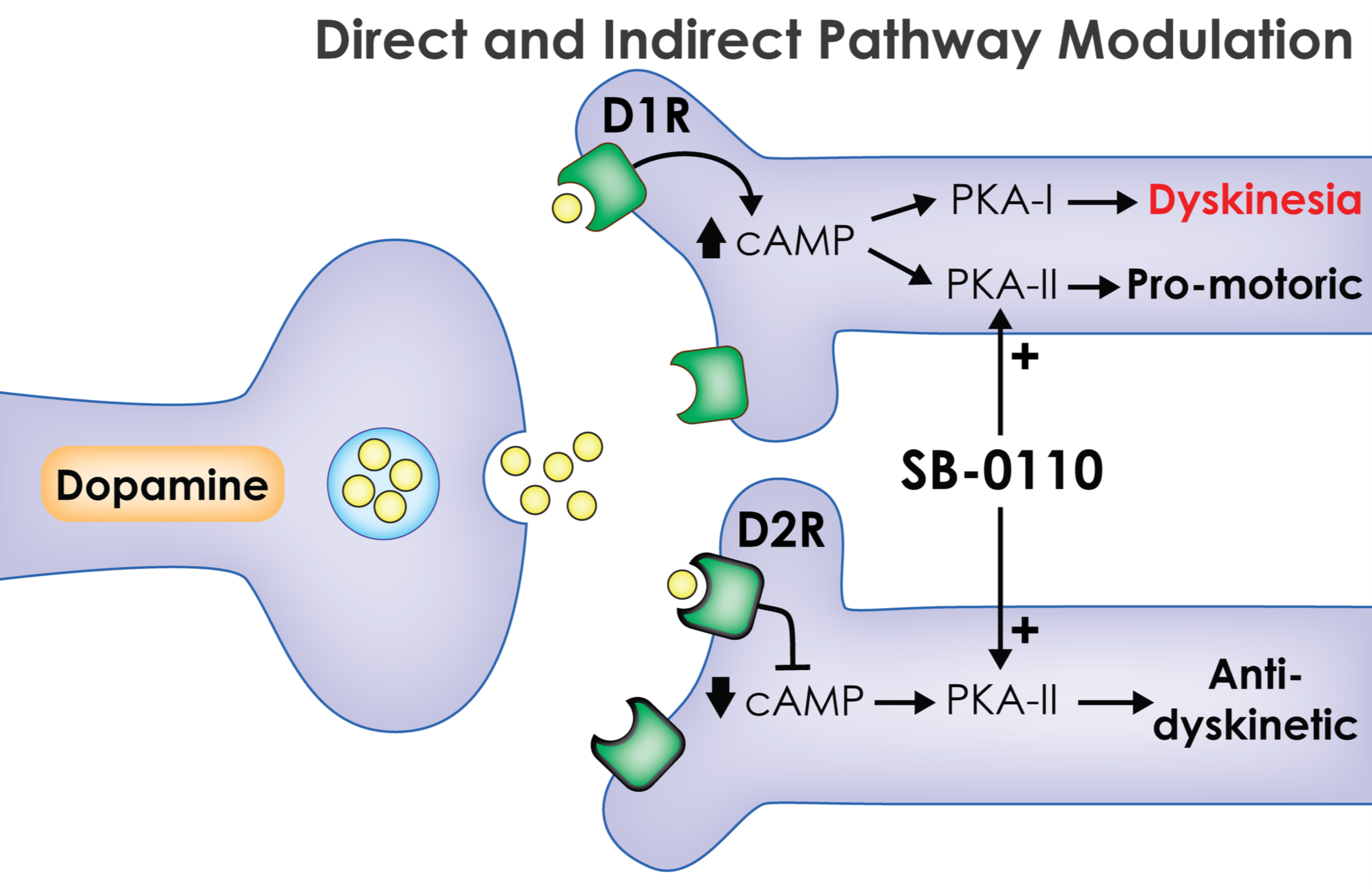
Current therapeutics are limited as they attempt to restore normal function at the receptor level, such as dopamine level modulators (e.g. L-DOPA, metabolic enzyme inhibitors) or dopamine agonists. PKA-II is the key kinase downstream of the dopamine receptor in both neuron types in the striatum, providing the opportunity for dual pathway restoration. This approach positions SB-0110 as a potential best-in-class therapy capable of addressing both PD and LID.
Extensive genetic evidence demonstrates that PKA-II plays a central role in movement control and PD:
- Location: PKA-II (PRKAR2B) is the predominant form of PKA in the striatum1,2
- Loss of function: PRKAR2B knockout mice have motor deficits, reduced responses to dopamine signaling, and develop age-related parkinsonism1,3,4,
- Gain of function: Increased PKA activity reverses parkinsonism in multiple mouse models4,5
- Brandon et al. J Neuro 1998
- Phan et al. Nat Comm 2024
- Adams et al. PNAS 1997
- Zhao et al. bioRxiv 2024
- Sano et al. SfN Conference 2025